HELM
HELM is an air conditioning company. Currently WIP, and pre-revenue, pre-raise. I know hardware is hard but I wanted to try something different.
I started because my flat is so fucking hot in the summer. Despite my Spanish wife enforcing her rules and routines of blinds down all day, living in the depressing dark, and with £400 worth of fans scattered about the flat, I was still avoiding being in my own home before 7pm. Not good.
I started looking at air-con units, and my entrepreneurial brain meandered, as it always does, to the business behind them. Why was every unit the same undifferentiated white box? Was there nothing that wouldn't look horrible alongside my Herman Miller chair and other East-London-coded-objects-that-signify-I-have-taste?
The more I looked the weirder it got. Air conditioning in Europe has no consumer brand. The biggest manufacturers are factories you've never heard of, everything is bought on price and energy rating, and every machine looks the same. Every heatwave, UK retailers sell out of the whole category in days — the reported sales spikes are genuinely silly numbers. And the homes that need cooling most, rented flats and old buildings, can't install fixed AC at any price, because you can't drill a condenser through a wall you don't own. So millions of homes will only ever have a plug-in machine, and every plug-in machine on sale is ugly.
The idea is one sentence: make the first air conditioner someone would leave out in their living room on purpose. The whole category competes on cooling numbers. Nobody competes on what the thing is like to live with, which is odd, because it lives in your bedroom.
TH30rY!
I do like a bit of theory, if anything for a bit of confirmation bias needed to fuel the fire at the start of any new endeavour. Here are the mental models I'll be leaning on with HELM.
The first is Seth Godin's purple cow. A brown cow is invisible; a purple one gets photographed. Most marketing budgets exist because the product itself is unremarkable, and the cheapest marketing is a product people can't help mentioning. That's the whole go-to-market: nobody has ever photographed their air conditioner on purpose, and if we can make the first machine that gets posted, commented on and argued about, the product does the advertising. My brother-in-law telling me it looked like a petrol pump and had no place in his room is this working, not failing.
The second is what Rory Sutherland calls reverse benchmarking: find the metric everyone in the category has neglected and be spectacular on it, rather than slightly better on the metrics everyone already fights over. Every AC brand benchmarks BTU, price and energy rating, which is why they've all converged on the same box. The neglected metric is what the thing looks like in your room for the ten months it isn't running. Nobody measures it, so nobody competes on it, so the position is empty.
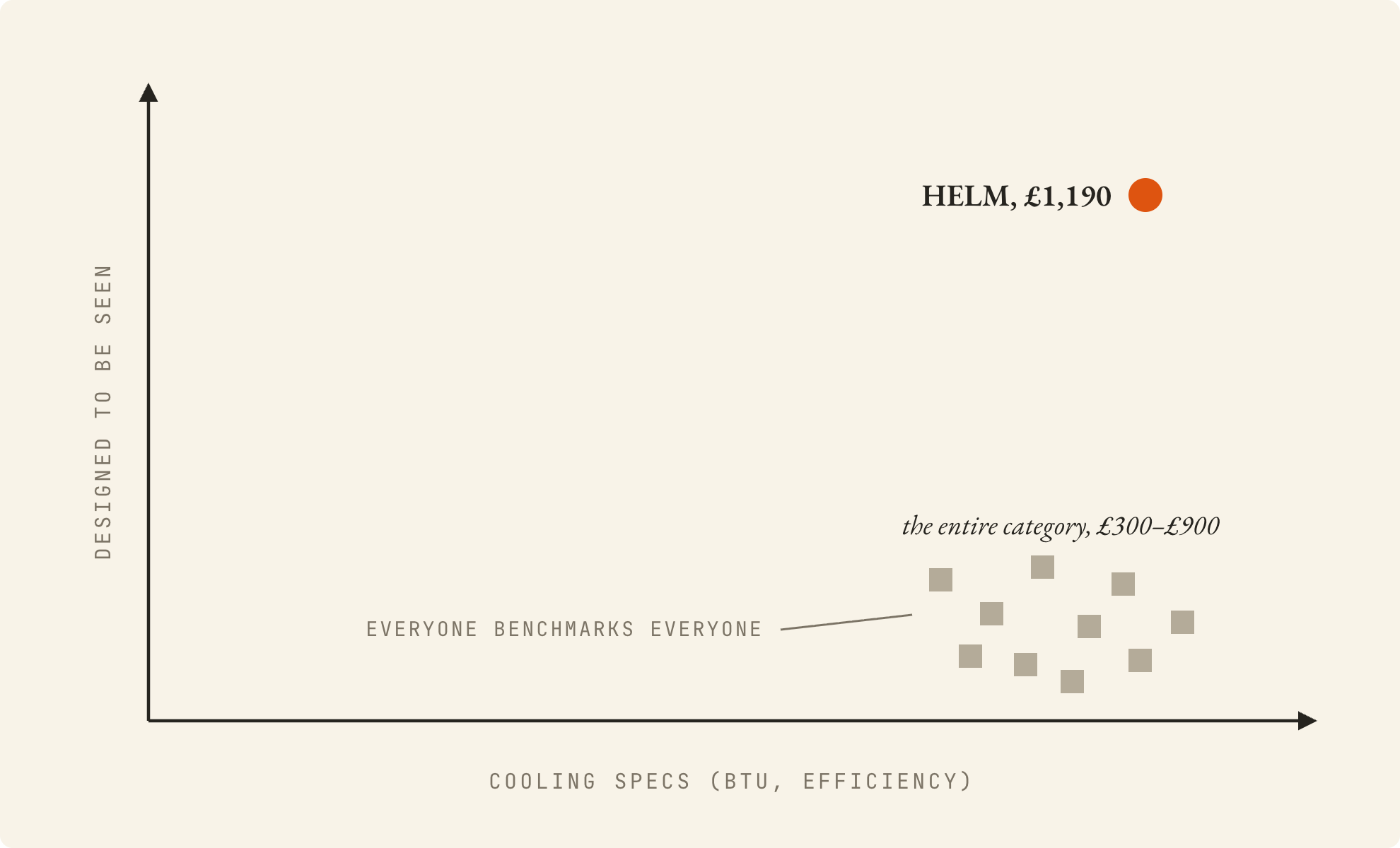
The third is the pricing gap. A decent portable costs £350–£900 and looks like office equipment. The design-led alternative is a fitted system at £9,000 plus building works. Between "cheap and ugly" and "beautiful and impossible" there is nothing, and that's where £1,190 sits. People already pay £550 for a Dyson fan that doesn't actually cool a room, so the willingness to pay for a nice object that moves air is proven.
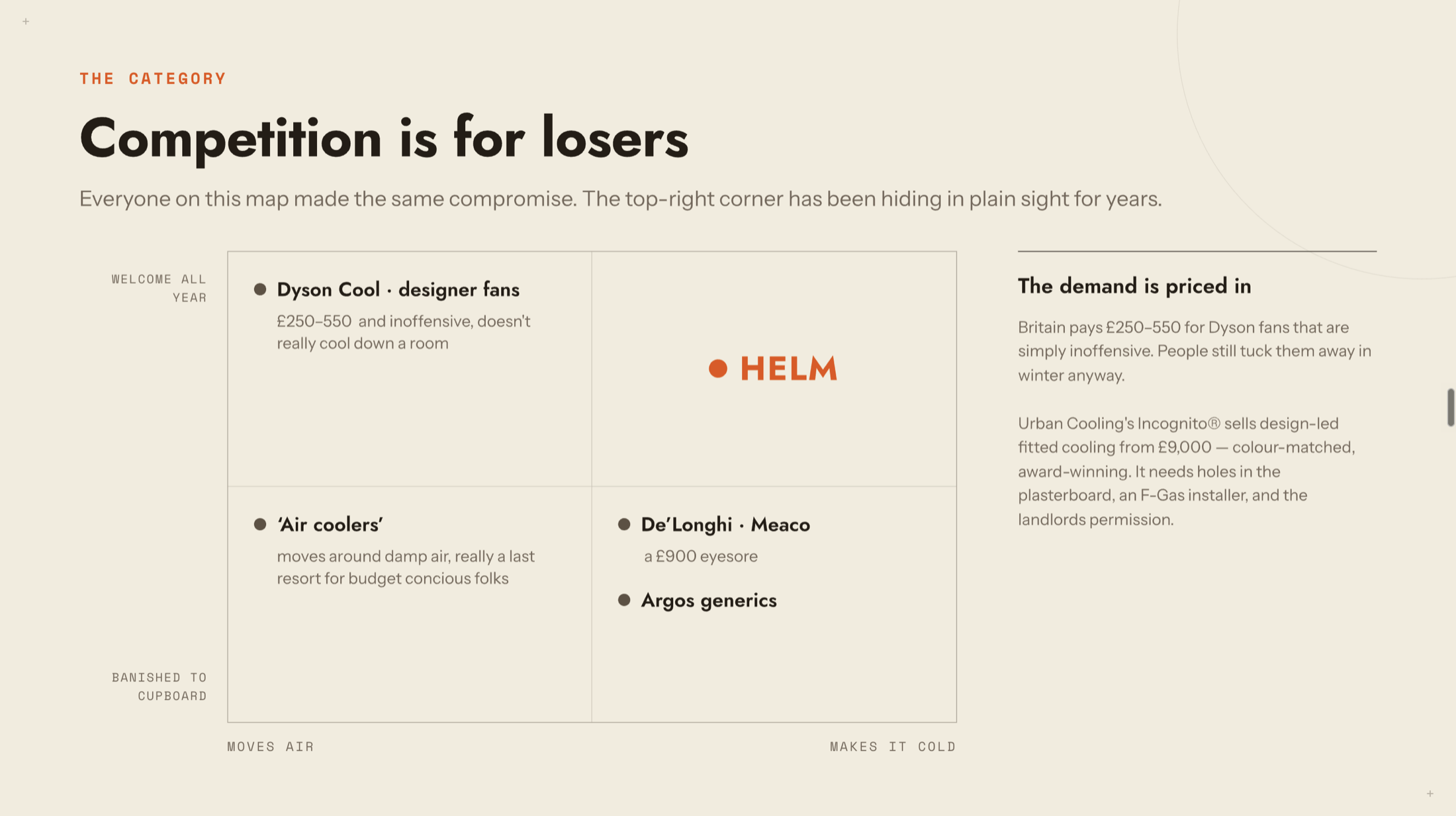
There's also an arithmetic point that stops this being purely a taste bet. Roughly 4.6 million private-renting households, about 1.7 million owner-occupied flats, and around a million heritage-restricted homes structurally cannot install fixed air conditioning — call it 8–10 million UK dwellings once you add a conservative slice of social housing. For all of them, a machine you carry in is the only cooling that will ever be legal and possible. That's not a niche; it's a third of the housing stock, locked in by tenancy law and Victorian brick.
Designing a machine that doesn't exist
HELM One is currently a design system and a set of AI renders. No prototype exists, and the website says so.
My driving philosophy for HELM is that it needs to create its own category. Like Smeg did for fridges, or Dyson did for fans. A design-first air-con unit that differentiates on its aesthetic sensibility and an illogical obsession with every design detail.
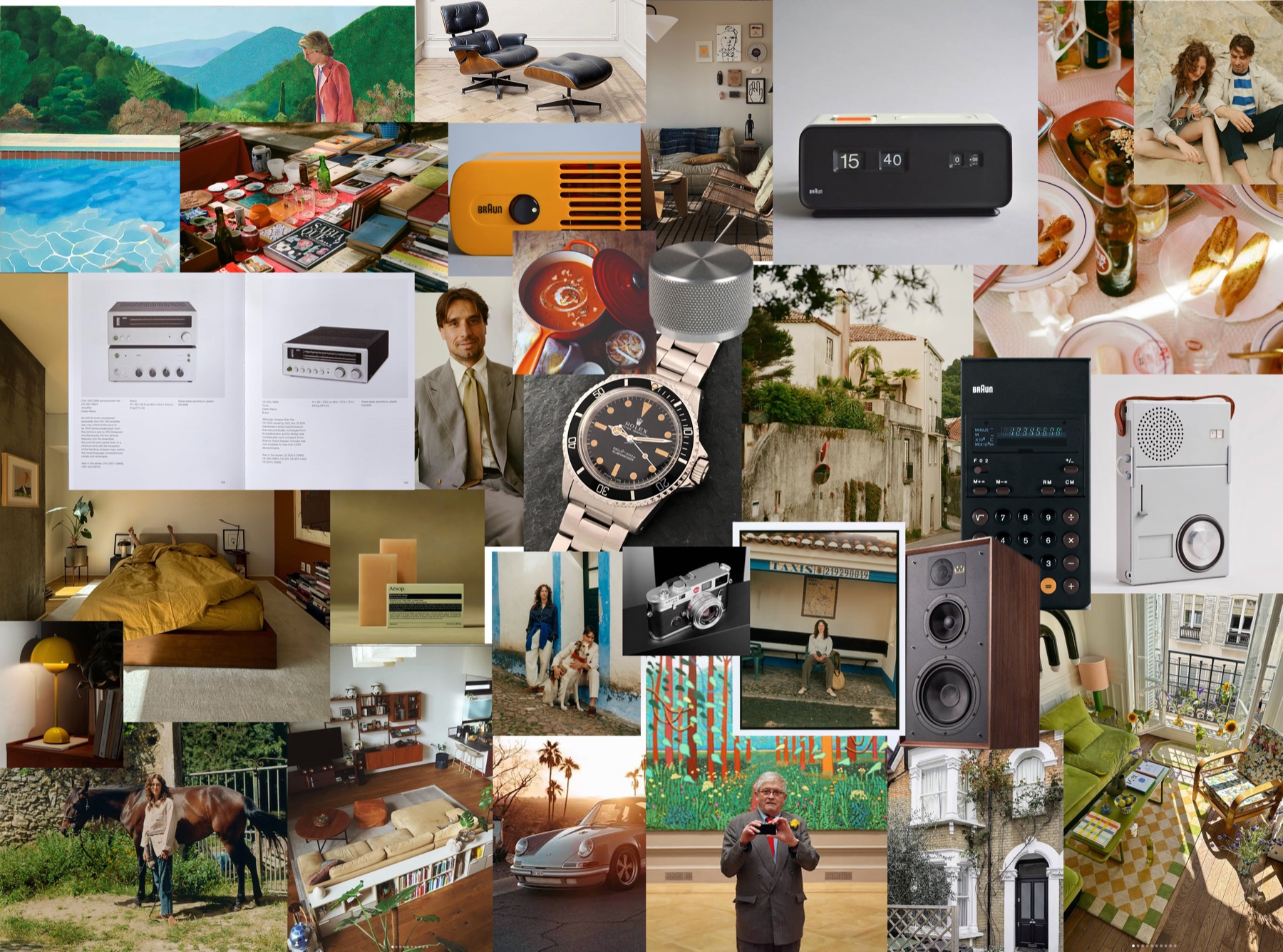
I played around for a couple of days with AI image generation tools trained on my aesthetic sensibilities, old Rolexes, older Porsches and anything Dieter Rams.
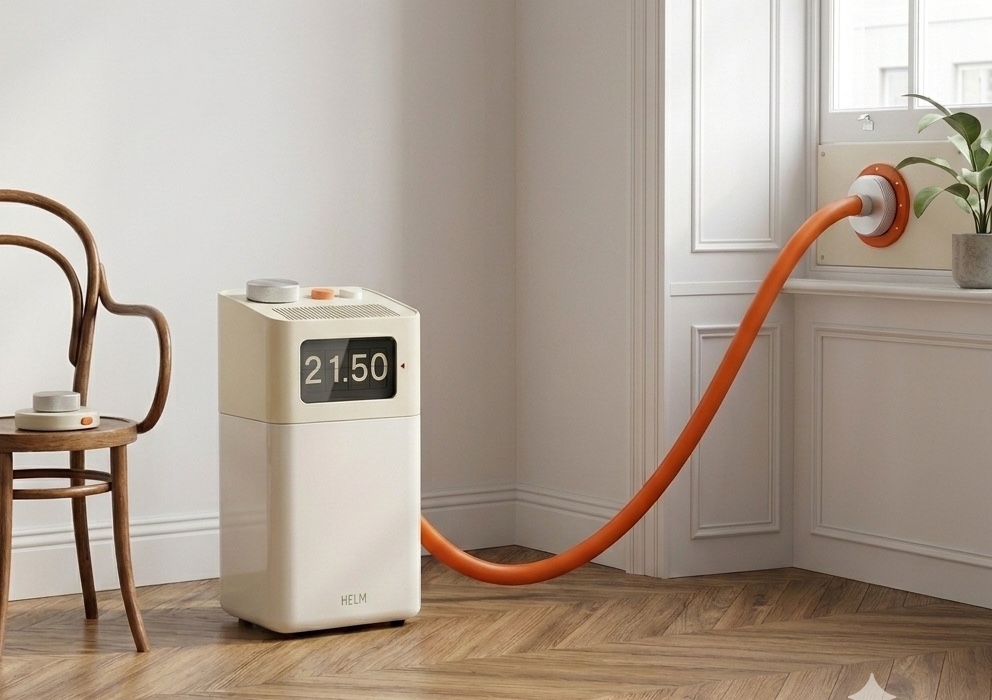
This is what I came out with, as a proof of concept.
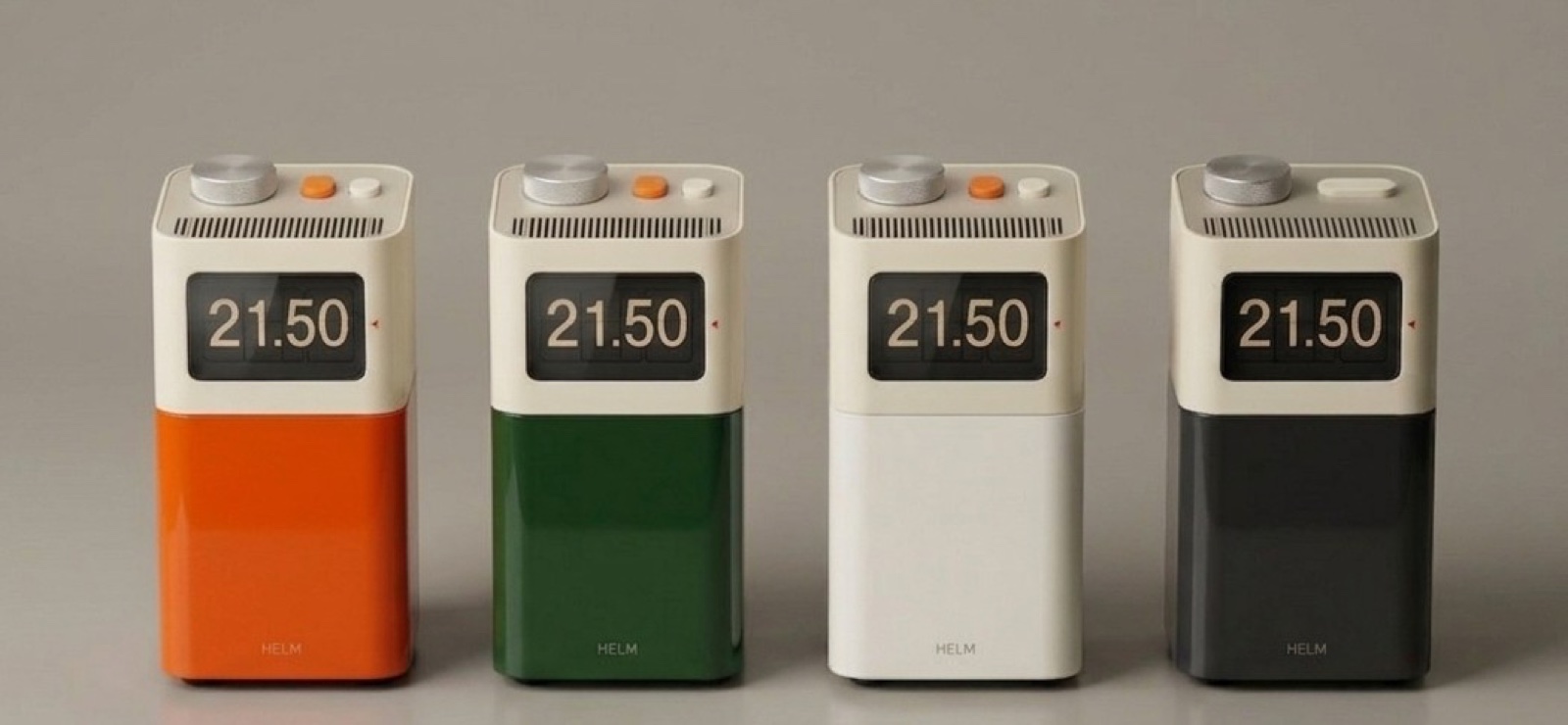
A 300×700mm tower. A real mechanical split-flap display — actual cards, not a screen, because nothing should glow in your bedroom at night and nothing should beep, ever. A machined metal dial for temperature and one orange button. A made-to-measure window panel, so installing it means giving us two measurements at checkout instead of wrestling a bag of foam. In winter the hose comes off, a glass top goes on, and it's a side table with a flip clock. If it's going to be out all year anyway, it should earn the space.
Then we rendered it over and over. This is harder than it sounds. Image models are great but also really shitty. They have no memory, so left alone they'll happily serve you slop with a different number of buttons in every image. What fixed it was treating the design like code: one written design doc with the colours, the materials, the exact display, and a banned list (screens, LEDs, visible screws), reference images attached to every prompt, and a log of what's decided versus what's still open. By the time our industrial designer started, his brief wasn't a mood board, it was a machine he could walk around, plus a requirements doc.
What we didn't do
We put the site and deck up early and didn't spend a pound on ads. I circulated it to friends and friends of friends and the result was what I wanted. People either loved it or hated it. When my brother-in-law told me it looked like a petrol pump and had no place in his room I knew we'd hit on something. There is no place for boring objects anymore; the whole marketing loop I have in mind for this product is based around sparking a conversation.
The other reason we didn't do ads, and also why I don't want to Kickstarter this, is that this category is fast factories with no brands, and a big pre-launch campaign is basically free market research for people who can tool up a copy faster than we can ship the original.
The data room
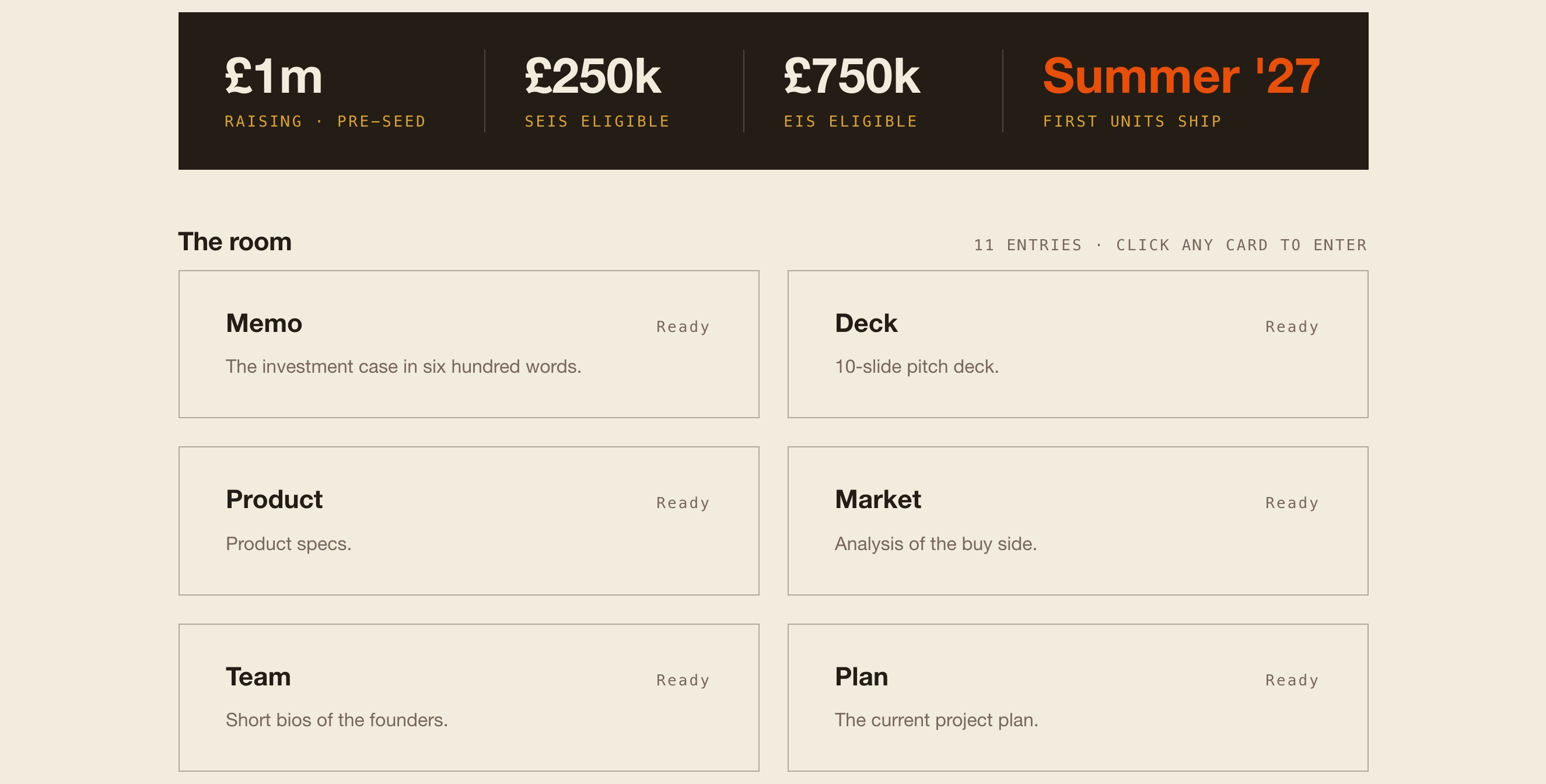
We're raising £1m (SEIS then EIS, the normal UK route), and the bit of the raise I'd actually show another founder is the data room. Instead of a PDF and a Dropbox link, it's a live site behind per-investor access tokens. I think it's like 10x better than any other data room I've seen.
The angel tool
Fundraising at this stage is mostly finding the right two hundred people, and it turns out the UK publishes the best list for free. Every time a company issues shares it files a form at Companies House (an SH01) naming who bought them. So the individuals who wrote angel cheques into Britain's design-led hardware companies — the pizza ovens, the folding e-bikes — are on public record, attached to proof that they do exactly this kind of deal.
I built the pipeline as two Claude Code agents in two terminals. Agent one finds comparable companies: UK, physical consumer product, design-led, with real share allotments on file. Agent two takes those companies and researches the people in their filings — what else they've backed, whether they're actually findable, why they'd care — and writes a one-screen brief per person with a source link for every claim.
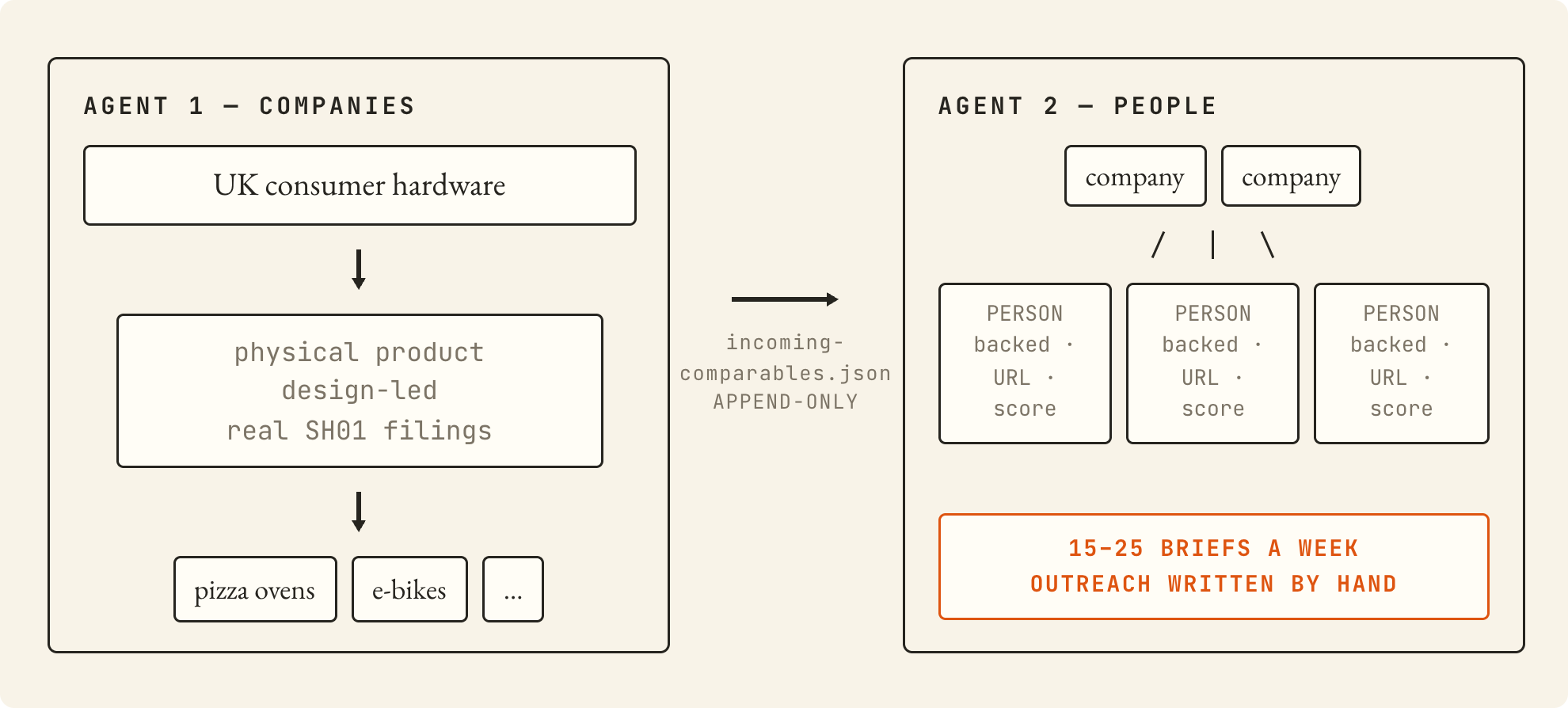
The rule carried over directly from Dupe Detective: the model is never the source of a fact. Every claim needs a URL, unknowns show as unknowns, and unknowns score near zero. The agents can't contact anyone. They fill a CRM and I write every message myself, because the UK angels who do consumer hardware are a few hundred people who mostly know each other, and templated AI outreach in a pond that small is a reputation you don't get back.
It went wrong in useful ways. The first run confidently listed a company's own founders as angel investors in their own company (fix: filter anyone appointed within a year of incorporation). A later run came back with five hundred "angels" because it had swallowed entire shareholder registers — employees, family members, crowdfunding punters — and scored 99% of them above the outreach threshold. A score that everyone passes ranks nobody. The actual signal turned out to be the boring one: people who appear in two or more comparable companies' filings. Repeat backers. That short list is the real asset, and it's maybe fifteen names.
Where it is now
No machine exists. The design is going from renders to engineering with a proper industrial designer, two manufacturers are pricing the build, the first investors are in the data room, and deposits open in the autumn.
In the Dupe Detective write-up I said startup building is finding one dimension where the competitive landscape is beatable. I think this is a pretty compelling version of that: a $27bn category that competes entirely on thermodynamics, entered on looks. I'll update this article if we make any progress...